Is Geometric Art Still a Influence on Current Art
The Dutch De Stijl movement developed as a response to the existential heaviness and stress caused by World War I. De Stijl artists pioneered an abstract form of fine art that was all about geometric designs and solid colors for the sake of finding a deeper and simpler spiritual and "universal" significant in art and life. These artists expressed themselves through painting, sculpture, compages, design, and many other modalities. Beneath, nosotros take a closer look at this advanced art (and cultural) motion.
Table of Contents
- 1 Historical Overview: The Ancestry of "The Style"
- 1.1 What Influenced the De Stijl Movement?
- ii Towards the De Stijl Fine art Definition
- 2.1 De Stijl Art Characteristics, Styles, and Artworks
- three Famous De Stijl Artists and Artworks
- three.i More than De Stijl Artists
- four De Stijl and Beyond: Towards the Modernistic
- 5 Frequently Asked Questions
- 5.1 What Was the De Stijl Movement?
- v.ii What Are the Main Characteristics of De Stijl Fine art?
- 5.three What Does "De Stijl" Mean?
Historical Overview: The Beginnings of "The Style"
The De Stijl move began in 1917 in Leiden, which is a city in South Kingdom of the netherlands in the netherlands. It lasted until most 1931, which was the yr when the founder, Theo van Doesburg, died and the encroaching political unrest from Nazi Germany began. The term De Stijl is Dutch and translates to "The Style" in English.
It was Theo van Doesburg, the Dutch architect, designer, and painter who started an art periodical called De Stijl. The other primary members and founders were the Dutch painters Piet Mondrian and Bart van der Leck, also every bit the Hungarian painter, Vilmos Huszár. The architects J.J.P. Oud, Gerrit Rietveld, and Robert van Hoff were also part of the De Stijl move.
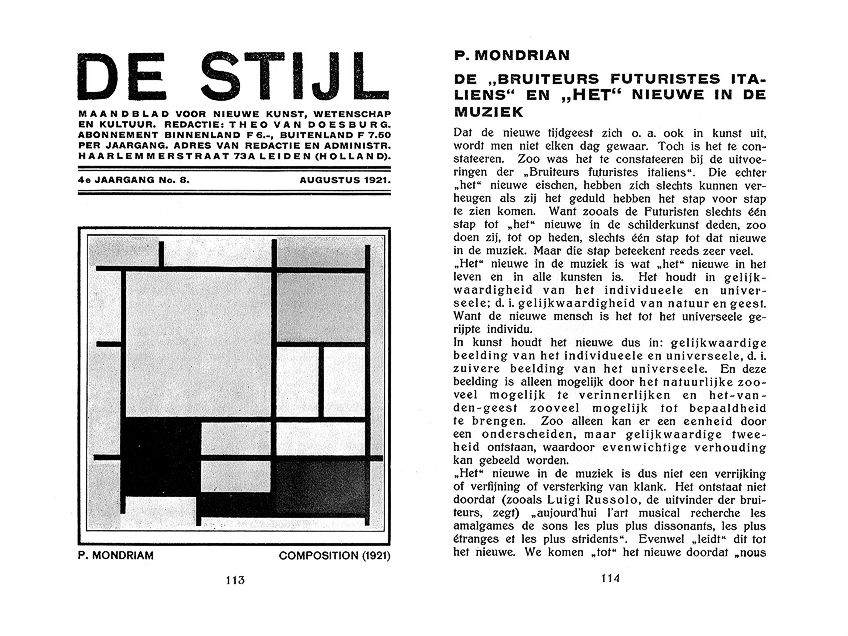 De Stijlmagazine, vol. Four, no. 8, pp. 113-114;Piet Mondriaan, Public domain, via Wikimedia Commons
The idea behind the periodical was to bring together similar-minded artists, designers, poets, and more to collaborate on a new abstract art style that went beyond painting. It sought to incorporate all types of art modalities similar design (for case, industrial blueprint), architecture, article of furniture design, music, literature like poetry, typography, and more than. The journal ready the theoretical foundations for the bathetic visual expressions while also giving De Stijl artists a platform to explore and express their theories so that others could exist involved and build upon them.
De Stijl became the overall art movement of the time with various other stylistic subsets related to painting and aesthetics within it, such as Neo-Plasticism and Elementarism. In fact, it was a whole new "style".
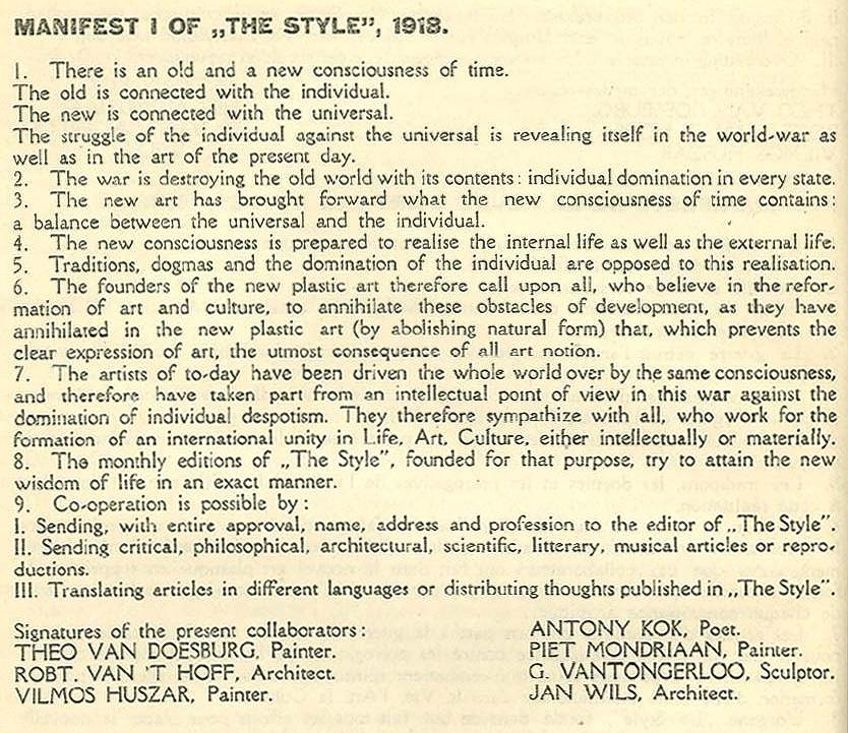 Manifesto I of De Stijl (The Mode) from De Stijl, vol. Two, no. ane, p. 4, Nov 1918;Theo van Doesburg (1883-1931), Public domain, via Wikimedia Eatables
In the year 1918, De Stijl members published a manifesto outlining nine principles about what the De Stijl motion stood for. De Stijl's main goal is frequently quoted, which succinctly sums up the movement: "the organic combination of architecture, sculpture, and painting in a lucid, elemental, unsentimental construction".
Some of the points described the old and new consciousness of the time, also as the focus on the private and the universal, for example, "the struggle of the individual against the universal is revealing itself in the world-war as well as in the fine art of the present-day". The movement was therefore a "reformation" of fine art and culture.
What Influenced the De Stijl Motility?
The De Stijl movement developed as a response to the existential and societal heaviness that came from World War I. It was a want for a Utopian globe, a earth that was harmoniously ordered. Spiritual ideas pervaded the overarching ideals of this motion.
In other words, where at that place was a trend towards more expressionism considering of the socio-political circumstances in Europe during the early 1900s, De Stijl moved in the other direction.
Information technology aimed to create a movement based on central, non-figurative ideas, as well as a spiritual essence of simplicity and geometry underpinning each visual work. The De Stijl motion was influenced past the ideas of several other art movements that existed before it.
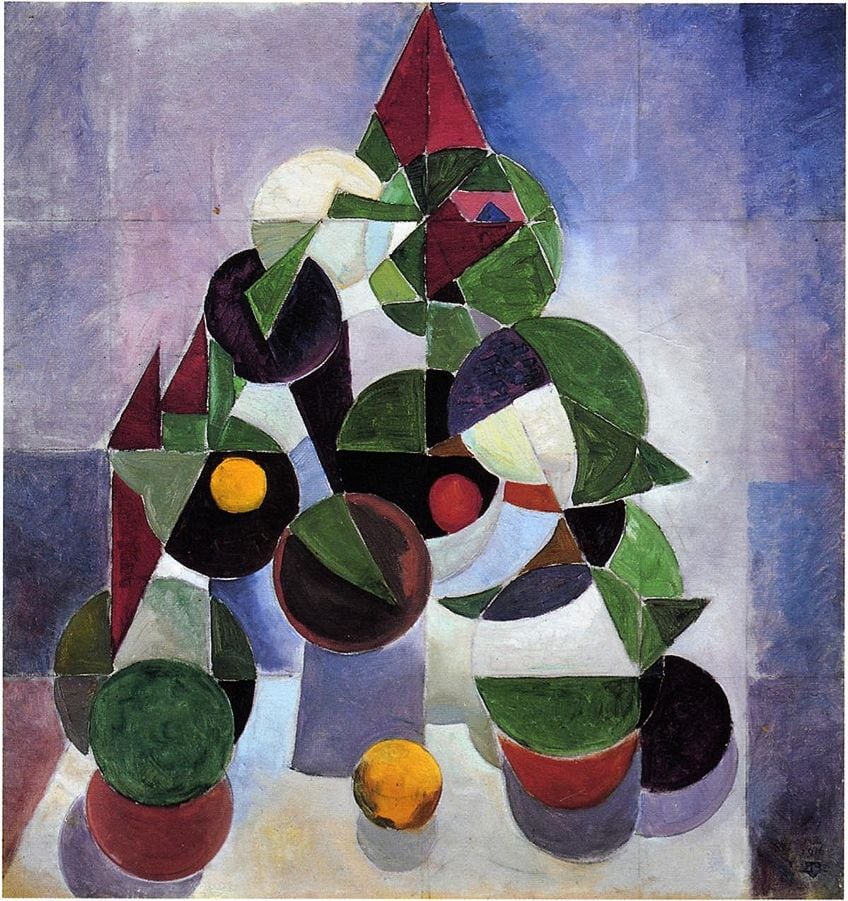 Composition I (However Life) (1916) by Theo van Doesburg;Theo van Doesburg, Public domain, via Wikimedia Commons
Influences include the Cubists like Pablo Picasso and Georges Braque, who pioneered the more than abstracted expression of forms. Another influential fine art movement is the Russian-based Suprematism, which was an abstract art movement founded by Kazimir Malevich in 1915. It was focused on the not-objectivity of art and geometric shapes. Additionally, the Russian-based Constructivism as well influenced De Stijl, which was founded in 1915 by Vladimir Tatlin and Alexander Rodchenko. Constructivism had an especially great influence on De Stijl compages.
The Theosophical Society
The Theosophical Society, which was founded in 1875 by Helena Petrovna Blavatsky, was another school of thought that influenced the De Stijl motion. It had other members like Rudolf Steiner who eventually took on the role of General Secretary in Germany.
The ideas behind Thou.H.J. Schoenmaekers' philosophy explored universal truths through simple and "ideal geometric" forms. Information technology is also described as a "mystical" credo by some sources.
The Neo-Platonic ideas from Schoenmaekers influenced De Stijl artists, especially Piet Mondrian, who established his fine art theory and visual mode chosen Neo-Plasticism, significant "New Plastic." Schoenmaekers'due south publications, Het Nieuwe wereldbeeld ("The New Epitome of the World", 1915) and Beginselen der beeldende wiskunde ("Principles of Plastic Mathematics", 1916) were specially influential resources.
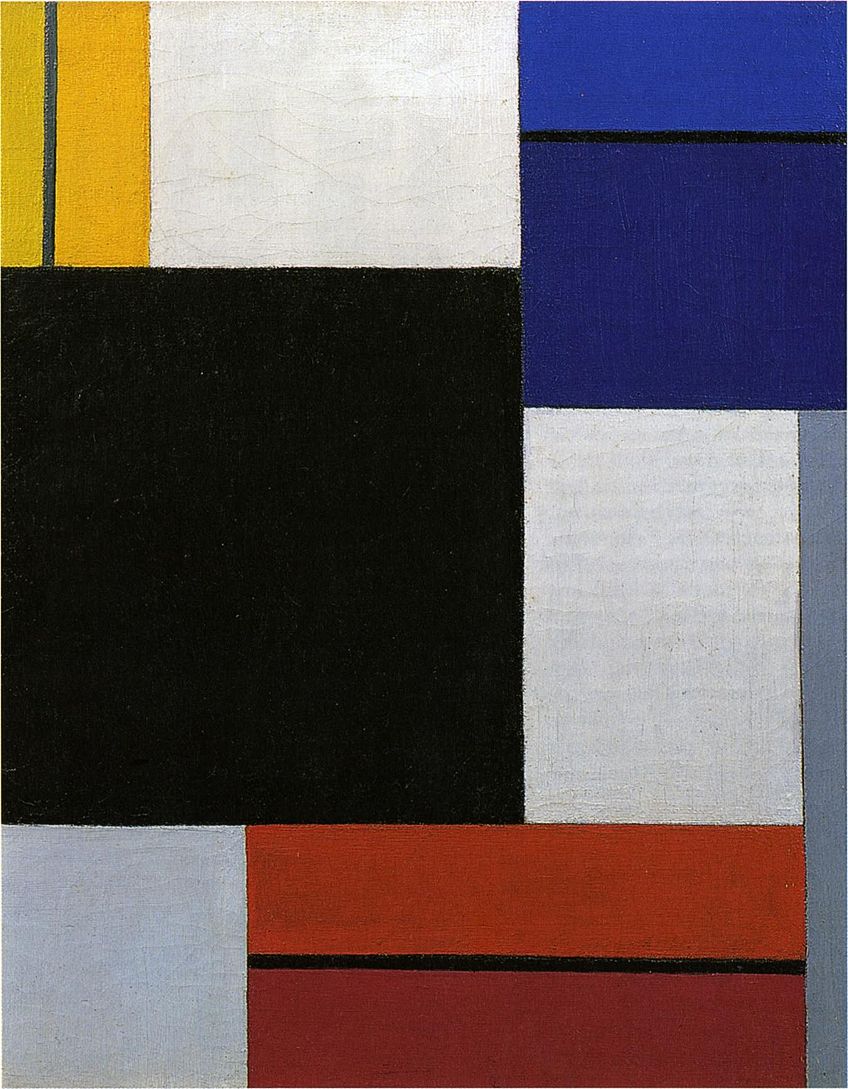 Composition XXI(1923) by Theo van Doesburg;Theo van Doesburg, Public domain, via Wikimedia Eatables
Schoenmaekers' quote is oft used to depict the influence he had on De Stijl artists ideas of form, where he said: "The two key and absolute extremes that shape our planet are: on the one hand the line of the horizontal force, namely the trajectory of the Earth around the Sun, and on the other vertical and essentially spatial movement of the rays that issue from the middle of the Dominicus…the three essential colors are yellowish, blue, and red".
Towards the De Stijl Art Definition
The De Stijl art definition can be improve defined if we look at the artworks produced during this time. Each piece is a concrete manifestation, and therefore definition, of what the motility was. Notwithstanding, knowing what the movement stood for will as well assistance united states of america understand the De Stijl fine art definition.
And so, let usa look at some of the characteristics and styles of this movement, too as a few of the main artists and their artworks.
De Stijl Art Characteristics, Styles, and Artworks
Co-ordinate to the Museum of Modern Art (MOMA) Bulletin (Volume Twenty, No. 2, Winter, 1952 to 1953), the De Stijl movement is characterized by iii "fundamental" principles. These are, "in grade the rectangle; in color the "primary" hues, carmine, blue and yellow; in composition the asymmetric balance".
This was at the eye and soul of the De Stijl movement, and to better sympathise information technology we need to look at two styles within the motility.
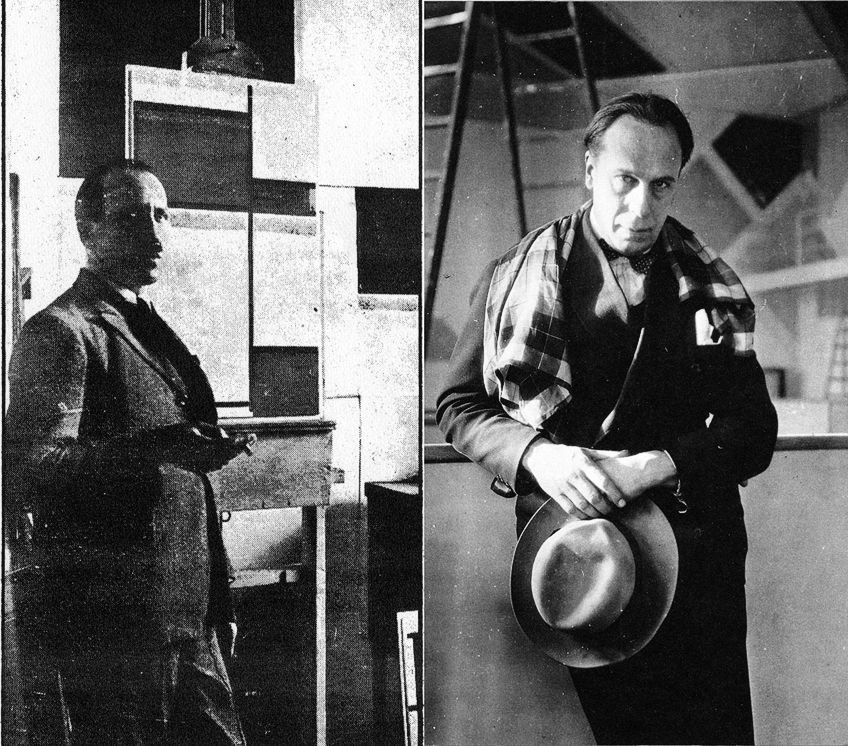 LEFT: Piet Mondrian in his studio in Paris, 1923;Anonymous Unknown author, Public domain, via Wikimedia Commons | RIGHT: Theo van Doesburg in the Aubette, Strasbourg, 1927;Anonymous Unknown author (photographer), Public domain, via Wikimedia Commons
At that place were two important styles inside the De Stijl movement, and it is of import to recognize that these were not synonymous with the overall movement called De Stijl, but they were products of it and applied past De Stijl artists. It became a seeming battle between the lines of Piet Mondrian and Theo van Doesburg. We had Mondrian opting for horizontal and vertical and van Doesburg going for diagonals. Below, nosotros explore the master tenets of each style.
Mondrian'southward Neo-Plasticism
Mondrian's quote from his essay, Neo-Plasticism in Pictorial Fine art (1917 to 1918), captures the essence of what he believed in; information technology was also through this essay that he introduced Neo-Plasticism. In it, he stated, "As a pure representation of the human being mind, art will express itself in an aesthetically purified, that is to say, abstract form. The new plastic idea cannot, therefore, take the form of a natural or physical representation".
Mondrian was influenced by his prior involvement in the Neo-Impressionism style and the color theory work done by its leading member, Georges Seurat. Mondrian too utilized his strong beliefs in theosophy to guide him in creating the fundamentals of Neo-Plasticism. He was a member of the Dutch Theosophical Gild.
Some of the characteristics of Neo-Plasticism include strict adherence to geometric shapes inside a composition.
Shapes include horizontal and vertical lines, or straight lines and rectangles. The surface of the composition, or the sheet, likewise needed to be a rectangular shape. Sometimes Mondrian tilted the canvass at an angle (45 degrees), and these De Stijl paintings are known as his Lozenge series.
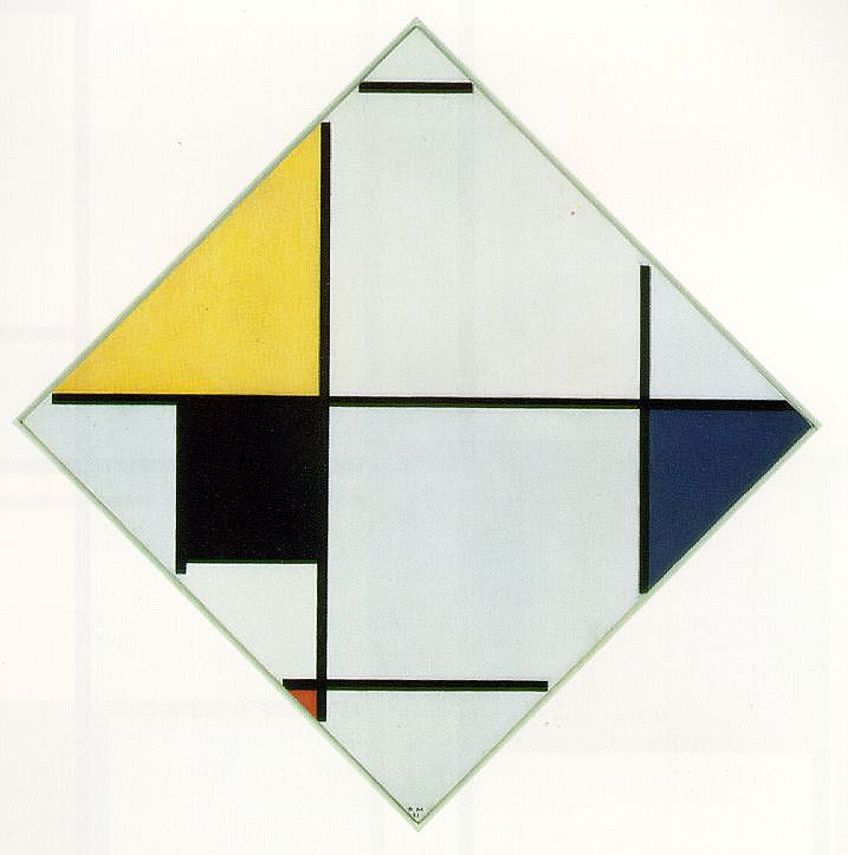 Lozenge Composition with Yellow, Blackness, Blue, Reddish, and Grey(1921) by Piet Mondrian;Piet Mondrian, Public domain, via Wikimedia Eatables
There was also a focus on asymmetry – Mondrian believed that harmony or remainder would be created through the positioning of geometric shapes. No other shapes similar circles were allowed in compositions, including whatever diagonals or curved lines.
Colors were besides strictly chief colors (blood-red, blue, and yellow), which would exist used against a background of primarily solid colors like white, black, or grey. In that location was as well a residuum between stark colors and stark lines, otherwise also described as "bold".
Neo-Plasticism was Mondrian'due south aim to portray "accented reality". It was a reduction of all, of what was believed unnecessary, such as elements of painting similar subjectivity or representation and other compositional techniques like perspective. It was to convey a sense of purity past returning to primal shapes and colors.
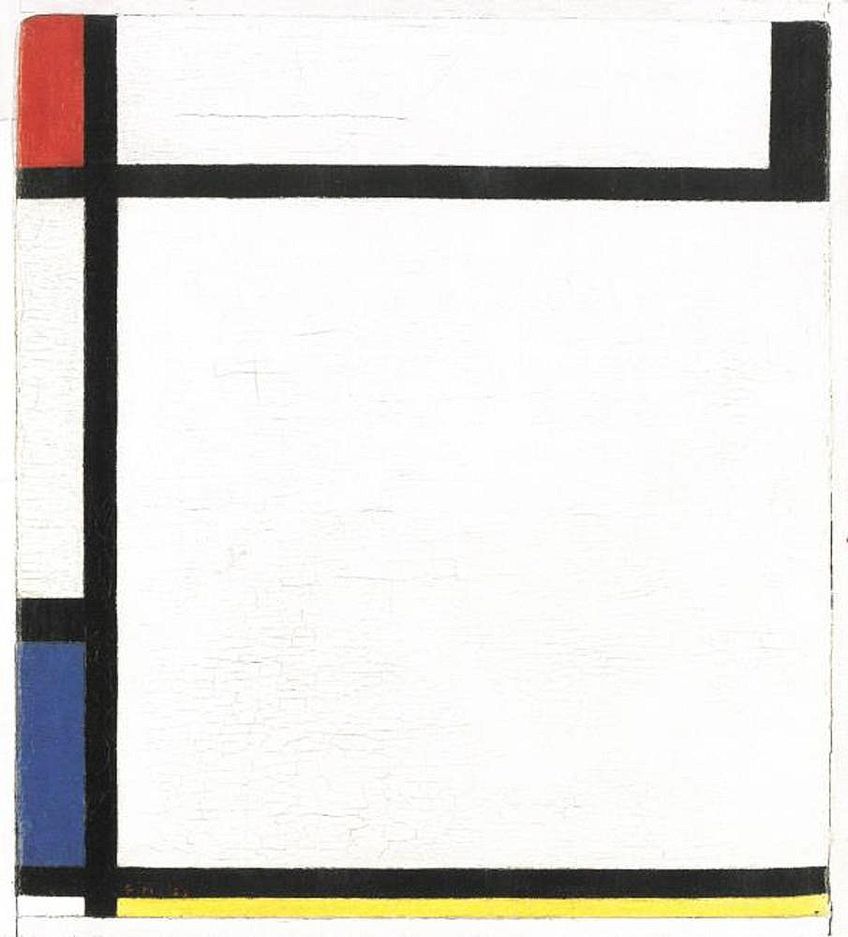 Tableau no. XI(1922) by Piet Mondrian;Piet Mondrian, Public domain, via Wikimedia Commons
Although most De Stijl artists prescribed to Neo-Plasticism, as the principles were outlined in the De Stijl periodical, many started to feel that this was too restrictive. From around the years 1921 to 1924, Theo van Doesburg broke away from the Neo-Plasticism style and started his own mode called Elementarism.
This led Mondrian to gradually break away from De Stijl, choosing to continue Neo-Plasticism and develop the manner independently.
The style developed throughout Mondrian's fourth dimension in Paris from 1919 to 1938, and and so London, from 1938 to 1940. Because of the war, he moved to New York and lived at that place, where his artwork reached new levels of inspiration.
Van Doesburg's Elementarism
Van Doesburg's Elementarism included diagonal lines, which held symbolic meaning for the creative person, related to movement and "dynamism". By adding diagonals and playing with various shades of colors, van Doesburg'due south artworks had a sense of liveliness. Many sources likewise signal that van Doesburg was more extroverted than Mondrian and their disagreements were because of stylistic preferences, which could be from personality dispositions.
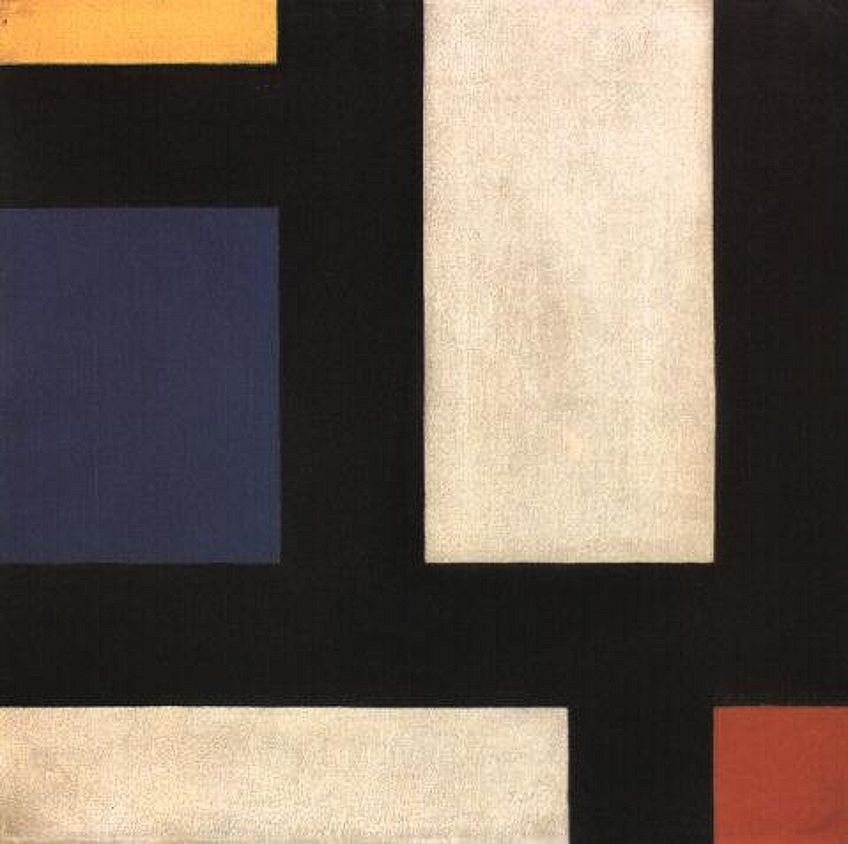 Counter-Composition IV(1924) by Theo van Doesburg;Theo van Doesburg, Public domain, via Wikimedia Commons
Furthermore, van Doesburg was involved in other artistic pursuits and styles, such as the Dada art movement, which he was a office of for a period. Van Doesburg also wrote and edited for the mag, Mécano. He wrote Dada poetry under the pseudonym, I.One thousand. Bonset. He also lectured at the Bauhaus school during the year 1921 and collaborated with diverse architects like Cornelis van Eesteren and J.J. Oud, producing many dynamic artworks over the years.
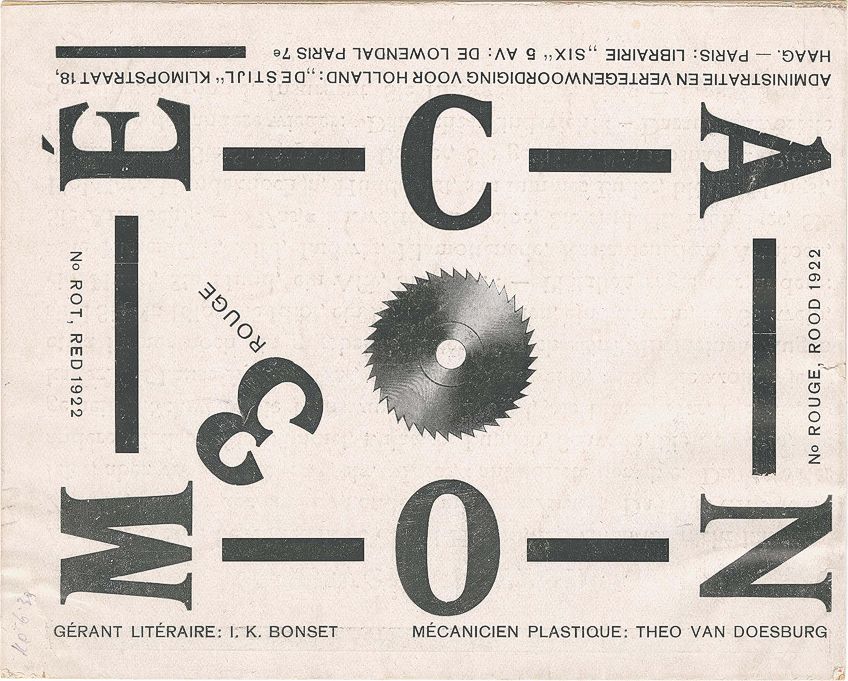 Embrace of Mécano magazine, event no. 3, "Ruby", 1922;Theo van Doesburg (1883-1931), Public domain, via Wikimedia Commons
The core ideals of Elementarism were written in the Elementarism manifesto by van Doesburg, titled Manifesto of Elementarism (1926 to 1928), including other essays written for the De Stijl journal. A notable departure in van Doesburg'southward manner was his fusion between painting and architecture. He wrote about this in the essay titled, Towards a Commonage Construction (1924), stating:
"We declare that painting without architectural construction (that is, easel painting) has no further reason for existence."
Famous De Stijl Artists and Artworks
In that location were numerous De Stijl artists, ranging from painters, designers, architects, sculptors, and more. Below, we look at a few of the famous De Stijl artworks that are testament to the motility's principles and avant-garde nature inside the art world, which also opened new forms of fine art into the Modern world.
Piet Mondrian (1872 – 1944)
Piet Mondrian's earlier artworks were Cubist experimentations and styles, every bit in the oil painting, The Gray Tree(1912). Nosotros run across the shape of a tree – the start of an bathetic limerick – emphasized by the lines and solid colors like blackness and gray. His piece of work Pier and Bounding main (Composition No. x) (1915) shows a articulate abstracted prototype, with minimal reference to the natural world. We as well notice how Mondrian composes his vertical and horizontal lines in the space.
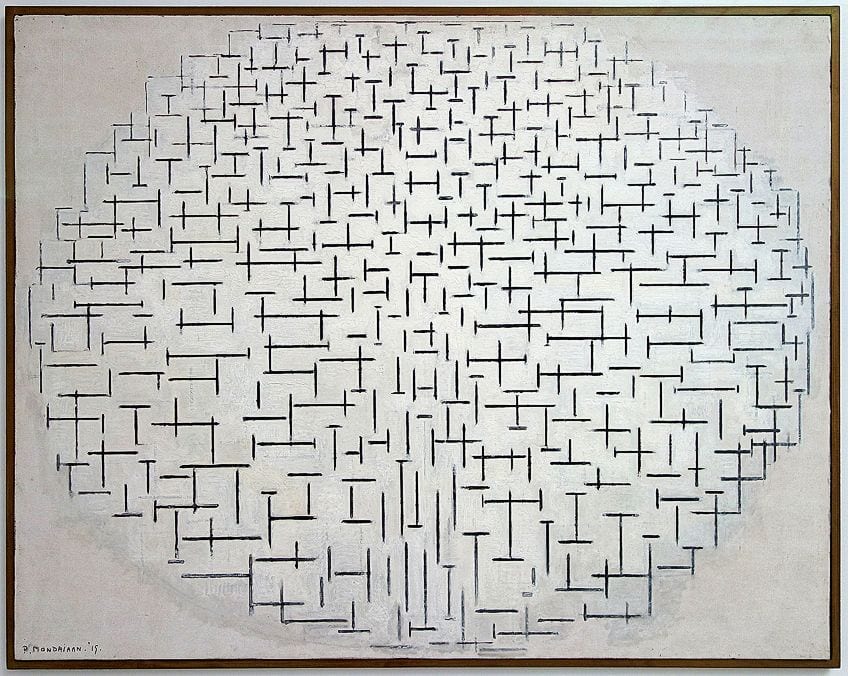 Composition No.10 (Pier and Bounding main)(1915) by Piet Mondrian; Piet Mondrian, Public domain, via Wikimedia Commons
Nosotros get-go seeing the feature De Stijl mode in Mondrian's oils, Limerick with Color Planes (1917) and Composition with big red plane, bluish gray, yellow, black, and blueish (1922). In both paintings, the artist depicts foursquare planes of color in seeming balance and harmonious construction on the sail.
However, the first painting has lighter colors while the latter painting has brighter colors, nevertheless sticking to the primary color scheme.
In Limerick with big red plane, bluish gray, yellow, black, and blue,we discover more than refinement in Mondrian's mode. In that location is a big red square in the center of the composition with various surrounding white blocks and some of colour. Thick black lines outline the squares, making them stand out even more. Furthermore, at that place is an asymmetry created due to the large and small-scale blocks.
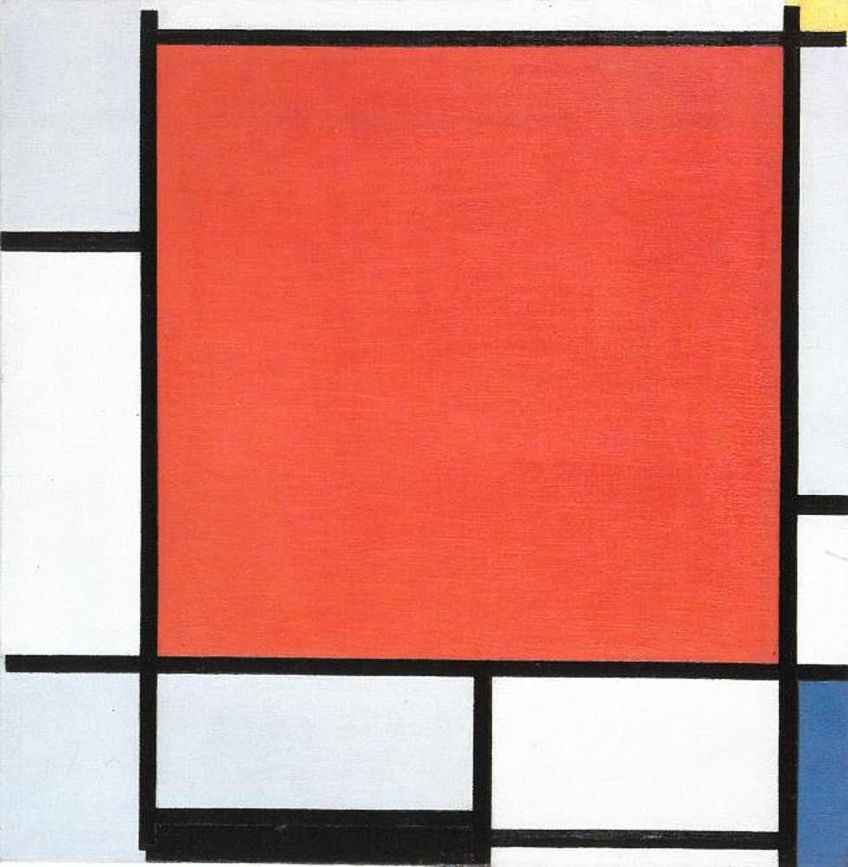 Limerick with big ruddy plane, bluish gray, yellow, black, and blue(1922) by Piet Mondrian;Piet Mondrian, Public domain, via Wikimedia Commons
Other artworks by Mondrian include his Composition Ii Carmine, Blue, and Yellow (1930), his Lozenge series of paintings, Tableau I: Lozenge with Four Lines and Gray (1926), and his later oil painting called Broadway Boogie-Woogie (1942 to 1943), which was more dynamic than his previous paintings. The latter was also one of his artworks from when he lived in New York, showing a change in the creative person's style and utilization of colors and form.
This is often attested to the lifestyle alter of living in 1 of the largest and culturally diverse and upbeat cities in the earth, besides as the influence of Jazz, which was prevalent at the time.
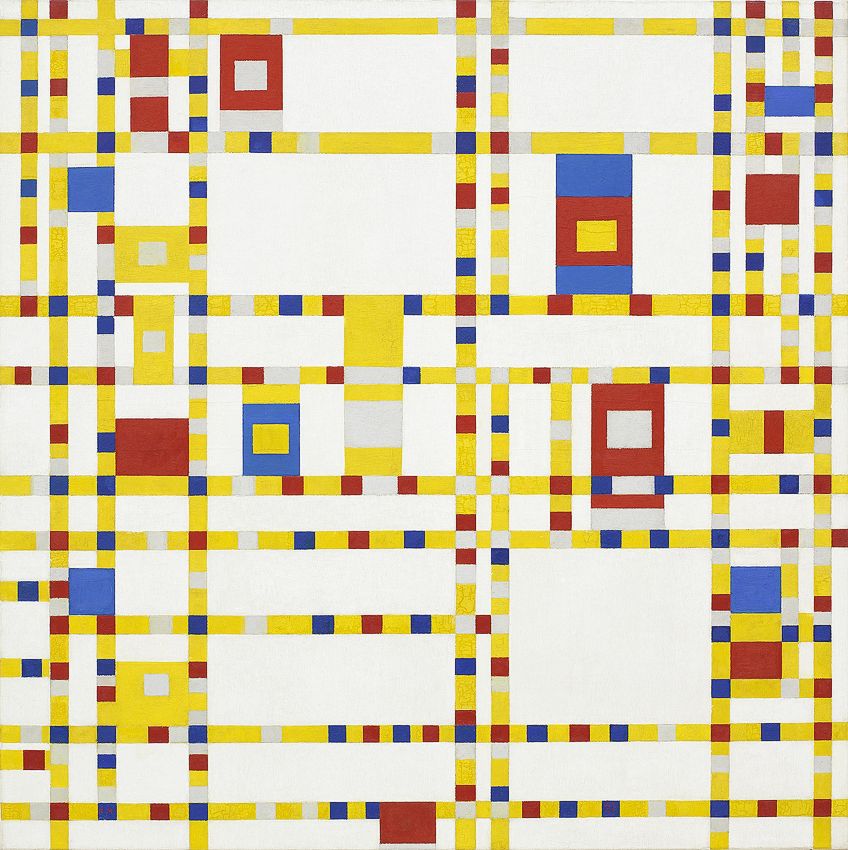 Broadway Boogie Woogie(1942-1943) by Piet Mondrian;Piet Mondrian, Public domain, via Wikimedia Commons
Theo van Doesburg (1883 – 1931)
Theo van Doesburg, the founder of the De Stijl movement, produced numerous examples of how bathetic forms chronicle to the overall message of the movement. We see this in his early works, Composition Viii (The Three Graces)(1917) and Composition VIII (The Moo-cow) (c. 1918). Although the titles suggest forms from the natural earth, in the oil painting the creative person reduced the subject thing to its fundamental shapes.
Van Doesburg besides created his signature "Counter-Composition" serial, which started to move away from the strict compositional structures set out by Mondrian.
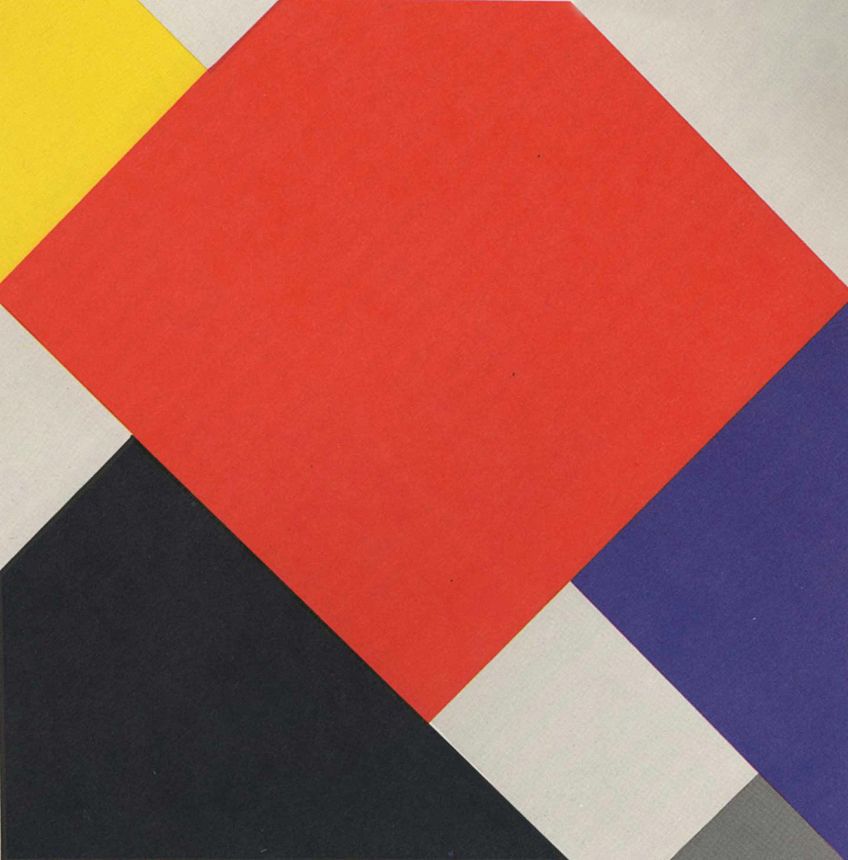 Counter-composition V(1924) by Theo van Doesburg; Theo van Doesburg, Public domain, via Wikimedia Commons
Examples from this serial include Counter-Composition V (1924),Counter-Composition VIII (1924), Counter-Composition VI (1925), andCounter-Limerick in Noise XVI (1925). We will notice the feature De Stijl painting diagonals in these oil paintings.
For case, in Counter-Composition 5, we notice almost exact similarities between Mondrian's paintings, only hither, van Doesburg flipped the geometric shape to 45 degrees. We besides meet the feature primary colors, with an additional grayness in the bottom correct corner of the composition. At that place are also no blackness lines between the shapes.
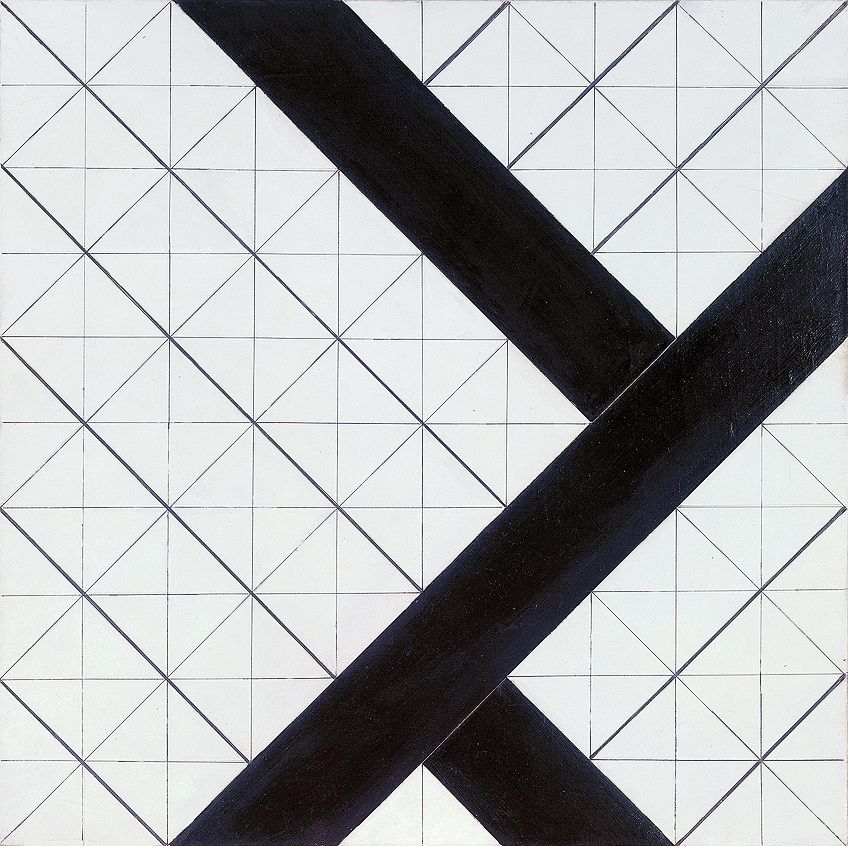 Counter-composition VI(1925) by Theo van Doesburg;Theo van Doesburg, Public domain, via Wikimedia Commons
In Counter-limerick VI, we notice black lines moving in well-nigh every direction and plane. Equally the groundwork, there is a grid with noticeable vertical and horizontal lines, and overlapping this is another grid with diagonal lines. Dominating most of the right side of the oil painting are three thick black strips forth the diagonal grid. This painting also shows how the background filigree is lighter in colour, the diagonal grid is bolder in color, and the forefront significantly highlights the blackness strips.
Furthermore, the composition appears almost similar an architectural plan or filigree, suggesting the artist's interest beyond painting.
In Simultaneous Counter-Composition, we notice an nearly playful version of ane of Mondrian's paintings. Van Doesburg has utilized the typical main colors, squares, and blackness lines, only here he has not stayed within the lines, and so to say. We observe the white groundwork, black, blue, reddish, and yellowish squares, and what appears to exist black lines for a border. The blocks are non positioned neatly alongside the other and the blackness lines are overlapping the square shapes, all every bit if the whole slice were knocked over, causing the shapes to come loose from the black lines, which manifestly announced diagonal, connected by a right angle.
Gerrit Rietveld (1888 – 1964)
Gerrit Rietveld was an architect and article of furniture designer. He is well-known for his Red and Blue Chair (1923), which became a symbol for De Stijl'due south manner, also showing usa its awarding across media across the canvas. This chair is designed with detailed precision in its colour, lines, and planes. Rietveld did not intend for any parts to intersect with the other, only simultaneously at that place is an coaction of each function. It is also made in a manner that suggests mass product. There is too an element of stylistic design over comfort.
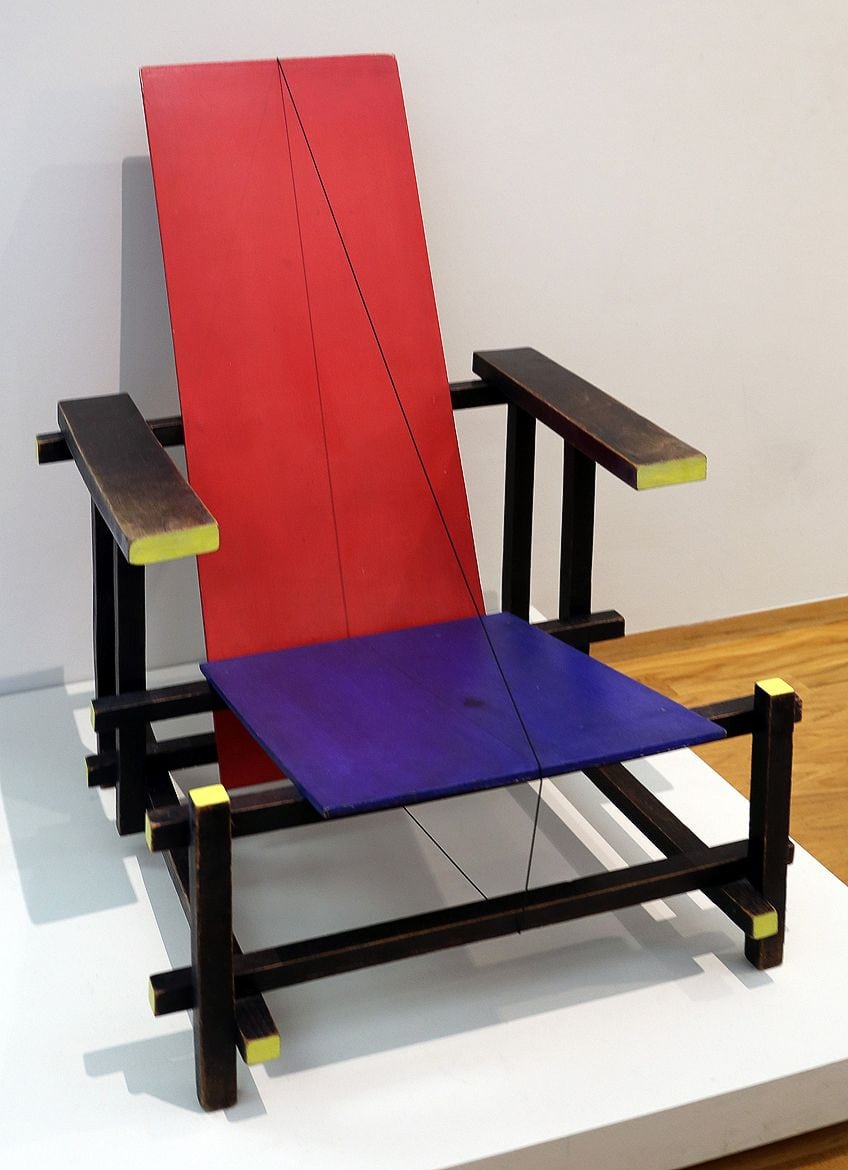 Red and blueish chair (1918) past Gerrit Rietveld;Sailko, CC BY 3.0, via Wikimedia Commons
Other works past Rietveld include his classic example of De Stijl architecture, the Rietveld Schröder Business firm (1924). Here, nosotros notice the style then characteristic of the De Stijl motility, again going across the canvas and existence applied to buildings (this is a articulate example of art and architecture condign a unified force).
The house appears as a iii-dimensional version of a De Stijl painting; we notice the primary colors xanthous, blue, and ruby-red in the beams near the windows and the larger areas of white, gray, and black that make up the outer walls of the house.
More than De Stijl Artists
Other De Stijl artists include Vilmos Huszár, who was a Hungarian painter, well known for his oil paintings in the De Stijl move likeMechano-Dancer (1922), which is different in style from the original Neo-Plastic style. At that place appears to be a form or shape suggestive of a torso or human being-like form. Nosotros too notice a freer utilization of the horizontal, vertical, and diagonal lines with a subdued color scheme.
Other De Stijl artists were architects and visual arts designers, such as the painter and ceramicist Bart van der Leck, who was a quiet and reserved fellow member of the De Stijl movement. Van der Leck somewhen left the movement in 1920, not signing the De Stijl manifesto.
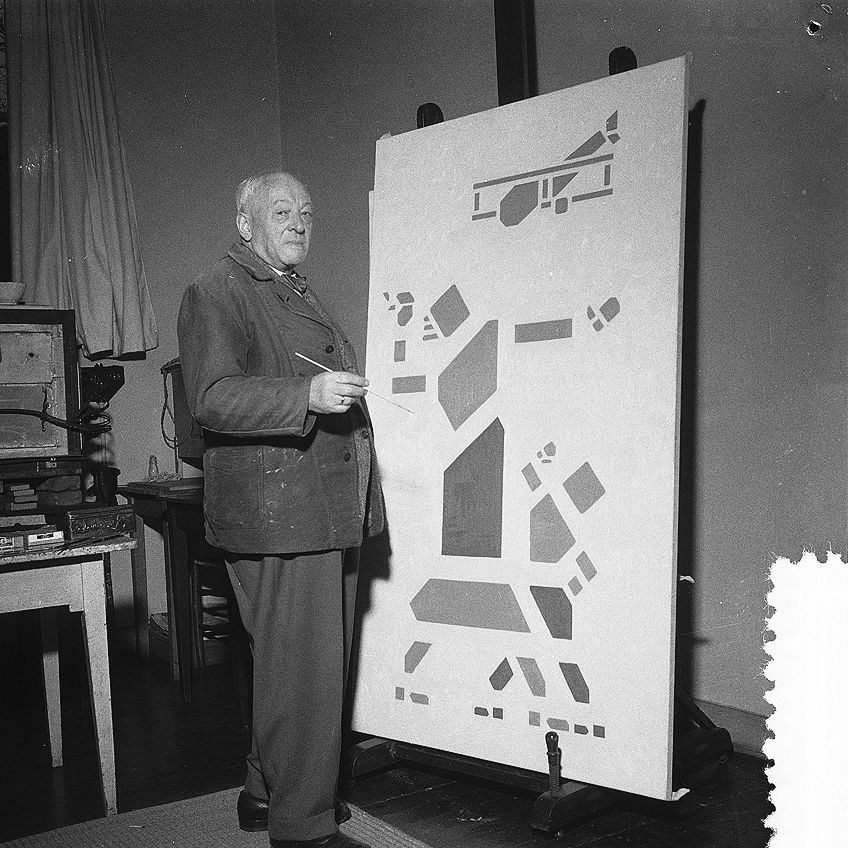 Photo of De Stijl artist Ben van der Leck, 1956;Daan Noske / Anefo, CC0, via Wikimedia Commons
Leading members in De Stijl compages were J.J.P. Oud, who was the Municipal Housing Builder for Rotterdam from 1918 to 1933. So there was Robert van Hoff, who designed furniture in addition to architecture. He besides provided financial aid to the De Stijl periodical.
Other members were Jan Wils, an architect, Georges Vantongerloo, César Domela, Cornelis van Eesteren, and Ilya Bolotowsky, who was a painter of Russian descent. He was influenced by Piet Mondrian and his characteristic vertical, horizontal, and main color scheme style of art. Bolotowsky painted in this manner besides and was a pioneer in developing the growth for abstruse artists through the American Abstract Artists clan.
De Stijl and Beyond: Towards the Modern
The De Stijl motion came to an end around the time when van Doesburg died in the early 1930s. Although this may take put a stop to the movement, it was kept live past what van Doesburg contributed and started within the move, along with many of the other artists, who all adult in their own way artistically. The De Stijl movement influenced Modern Fine art, the International Style in architecture, the Bauhaus motion, and many other mod artists like Mark Rothko, Frank Stella, Dan Flavin, and Donald Judd.
De Stijl, and everything information technology stood for, gave not just painting only design and architecture a new meaning. With its strong theoretical and contemplative focus, it challenged the way artists of all modalities viewed art and the interaction and relationship with form, color, and limerick – in 3 dimensions or 2, and the merging of the mystical and spiritual. It was most a "back-to-nuts" style of fine art that sought the underlying truth when all excess of form was removed.
Frequently Asked Questions
What Was the De Stijl Motility?
The Dutch architect, designer, and painter, Theo van Doesburg, started an art journal chosen De Stijl. The journal set the theoretical foundations for the abstracted visual expressions, it also gave De Stijl artists a platform to explore and limited their theories. De Stijl is the term designating the fine art motility in the netherlands during the 1900s. It had two subset styles, namely, Neo-Plasticism and Elementarism.
What Are the Chief Characteristics of De Stijl Art?
The main characteristics of the De Stijl movement can be viewed as three "cardinal" principles. These are geometric forms, in other words, vertical and horizontal lines and rectangles; a color palette of just primary colors, ruby-red, bluish, yellow, and solid colors like black, white, and gray; and an asymmetrical composition, which achieves a balance.
What Does "De Stijl" Mean?
The term De Stijl is a Dutch word that translates to "The Style" in English. It was the name given to the Dutch art journal, which was started in the early 1900s by Theo van Doesburg and Piet Mondrian, among other Dutch artists, architects, sculptors, and designers.
Source: https://artincontext.org/de-stijl-art/
0 Response to "Is Geometric Art Still a Influence on Current Art"
Post a Comment